




Is it still useful?
In the age of mobile job search applications, it’s legitimate to ask the question. However, skipping the cover letter would be a mistake, as most employers still rely on this document to make an initial selection among candidates. Indeed, faced with two equivalent resumes, it’s the cover letter that will make the difference. It would be a shame to miss out on an interview because of a cover letter that is poorly presented, poorly written… or not written at all.
How to structure your cover letter?
Structure is essential when writing a cover letter, as it follows conventions that recruiters expect. After the greeting, it begins with an opening statement that introduces the body of the letter in three parts (the well-known "you, me, we" approach), and ends with a concluding sentence and a polite closing.
The greeting is the "Dear Sir/Madam" that introduces your letter. Don’t hesitate to personalize it if you know the title or name of your contact, but be careful to write it correctly. Nothing is more off-putting than a misspelled name.
The opening statement explains the purpose of your application. You can use it as an opportunity to stand out with a memorable sentence, but be careful with originality. Always maintain a professional tone and avoid overly personal references if you want to be taken seriously.
Examples:
"Your job posting for a position as [position] caught my attention and I am therefore submitting my application."
"Wishing to give a new impetus to my career, I am very interested in the position of […] to be filled within your company."
The body of the letter
1. The "you" (the company): show that your application is intentional
This is the part that the recruiter will read first and that will give them the desire to know more. You must therefore pay particular attention to it. The goal is to demonstrate that you know the company and that your application is motivated by elements of its organization, its values or its current events. To do this, take the time to inform yourself about the company by consulting its website for example. The goal is to retain one or two topics that show your affinities with your future employer, the targeted position or its business sector.
Example:
I learned in the press that your establishment planned to expand its offer by opening a pastry counter, and I am particularly sensitive to your eco-responsible approach that prioritizes artisanal production, organic and local raw materials.
Mistakes to avoid:
- Asserting your qualities without supporting them with examples.
- Copying your resume without deepening it.
- Mentioning bad relationships with a former employer or denigrating them.
- Mentioning details of your personal life unrelated to the position (age, family situation, number of children).
- Saying how long you’ve been looking for a job.
2. The "me": prove that you are the ideal candidate for the position
Carefully analyze the job posting text to understand the needs and expectations of the employer and show how you can meet them through concrete examples. Without paraphrasing your resume, detail one or two situations where you have been able to implement the skills sought by the recruiter. To do this, use action verbs, highlight your successes, if possible with quantified examples.
Example:
My experience in the hotel industry has allowed me to acquire skills in team management and customer relations. As director of the [...] hotel, in addition to leading a team of fifteen people for five years, I demonstrated my management qualities by contributing to achieve 15% savings on the budget devoted to site overhead costs.
Personal qualities such as autonomy, flexibility, creativity or interpersonal skills are highly valued by companies. Don’t forget to highlight them by illustrating them with examples from your professional or personal activities, such as your experience as a basketball team coach that highlights your team spirit.
If you are an inexperienced candidate, or in career transition, the cover letter is particularly useful to explain your professional project to the recruiter. Use it to explain your career goals and show how your skills—gained through studies, internships, or other roles—are transferable. Emphasize your motivation, willingness to learn, and long-term commitment.
3. The "we": project yourself into the future collaboration
Help the recruiter imagine you in their team by explaining what you can bring to the company and how your collaboration will contribute to the smooth running of a service or the success of a project. This is the time to convey key messages summarizing your main qualities.
Example:
Having already supervised the creation of a quality service, you can rely on my technical knowledge in engineering and my dynamism in team management to successfully develop a quality control policy common to all your subsidiaries.
Then write the concluding sentence. Before ending, encourage the recruiter to meet you in an interview by indicating that you are at their disposal for any additional information. Show confidence in yourself and avoid too hesitant turns of phrase.
Example:
I will be happy to make myself available to meet you and discuss ways to effectively optimize your computer system.
Polite formulas are often neglected while they are essential to end a letter with courtesy. No need to rack your brains, you just need to choose one among the established formulas while being careful to use the same denomination as in the greeting.
Example:
Yours sincerely, Dear Sir/Madam, my best regards / my distinguished regards / my respectful regards.

What about the presentation?
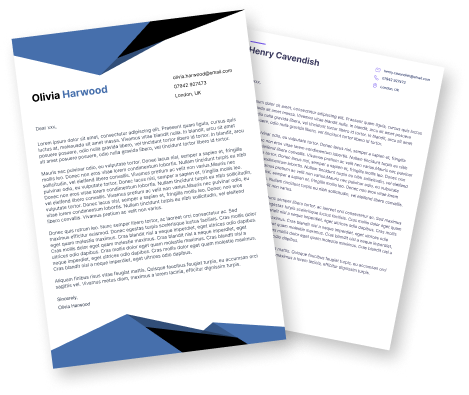
As recruiters spend little time on each letter, it is essential to take care of the layout. Opt for a clear and airy presentation. Select a simple and readable font like Arial, Calibri or Times New Roman in size 10 to 12 point.
The header must include your contact information on the left (name, first name, address, phone number and email address) and those of the recipient on the right. Don’t forget to indicate the job title and its reference in the subject line.
In terms of style, be direct, your letter must fit on one page. Write short, concise sentences and adopt a neutral and professional tone. Colloquial or too pompous language is to be avoided.
Spelling and grammar remain an important criterion for recruiters. Don’t rely on automatic spell checkers which are not always reliable. Proofread yourself, or have someone proofread you, carefully to not let any mistakes slip through.
You’ve probably understood by now: the key to a strong cover letter is personalization. Sending the same generic letter to every employer is not effective. Even if you start from a template, make sure to tailor it for each application.
Still unsure where to start?
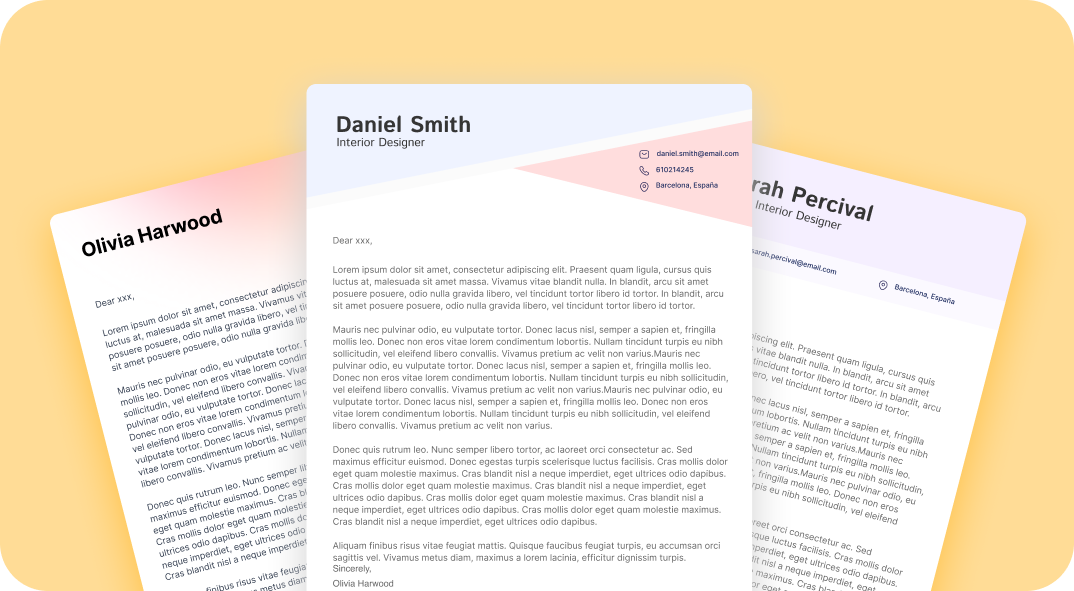
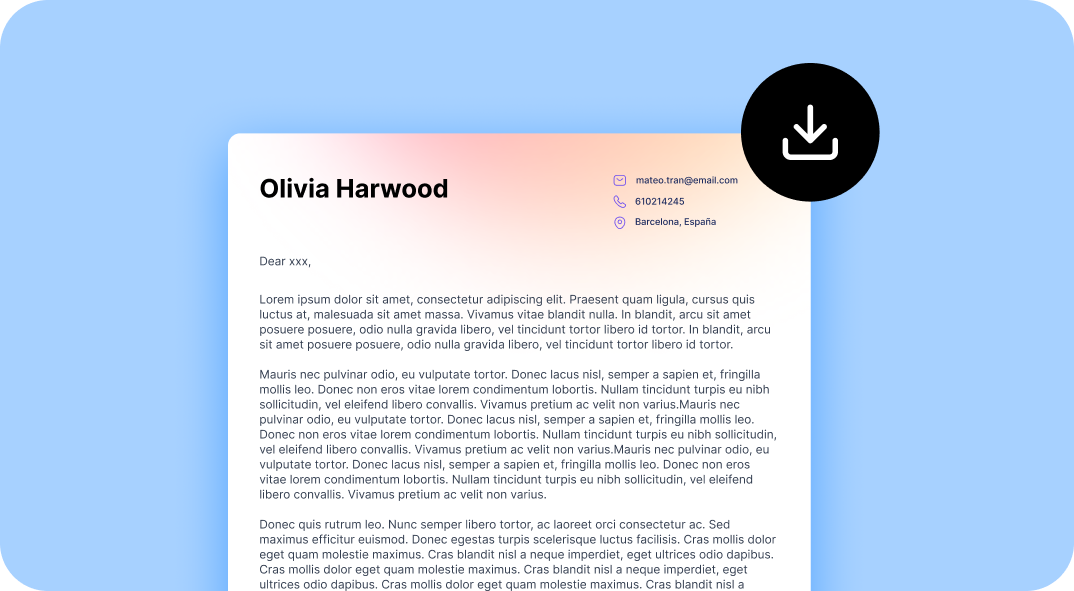
To avoid mistakes, :siteName offers you a wide range of customizable letters. Our pre-formatted templates declined by type of job and business sector will save you some time. You just have to fill them in!
In summary:
- The cover letter bridges the gap between your resume and the targeted position.
- It allows you to demonstrate that you know your future employer and that your profile matches their expectations through concrete examples from your experience.
- It must complement your resume without repeating it, be concise, well presented and contain no spelling mistakes.